Soccer Power Shot Biomechanics and Kick Analysis
See how Petroski Physio analyzes the full soccer power shot using slow-motion biomechanics, objective strength testing, and each athlete’s injury and performance history.
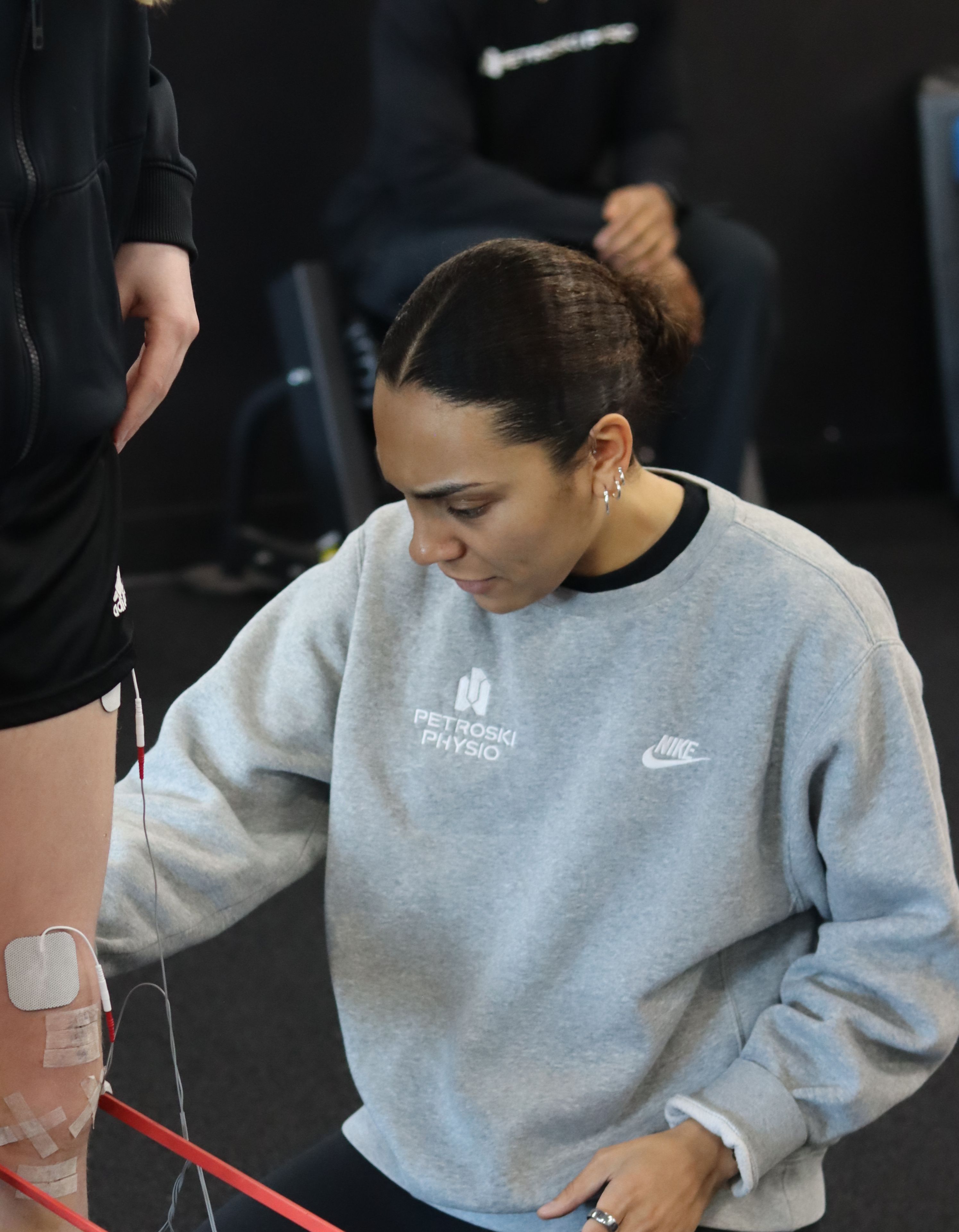
Taylor Bracy DPT, Alison Heckman SPT
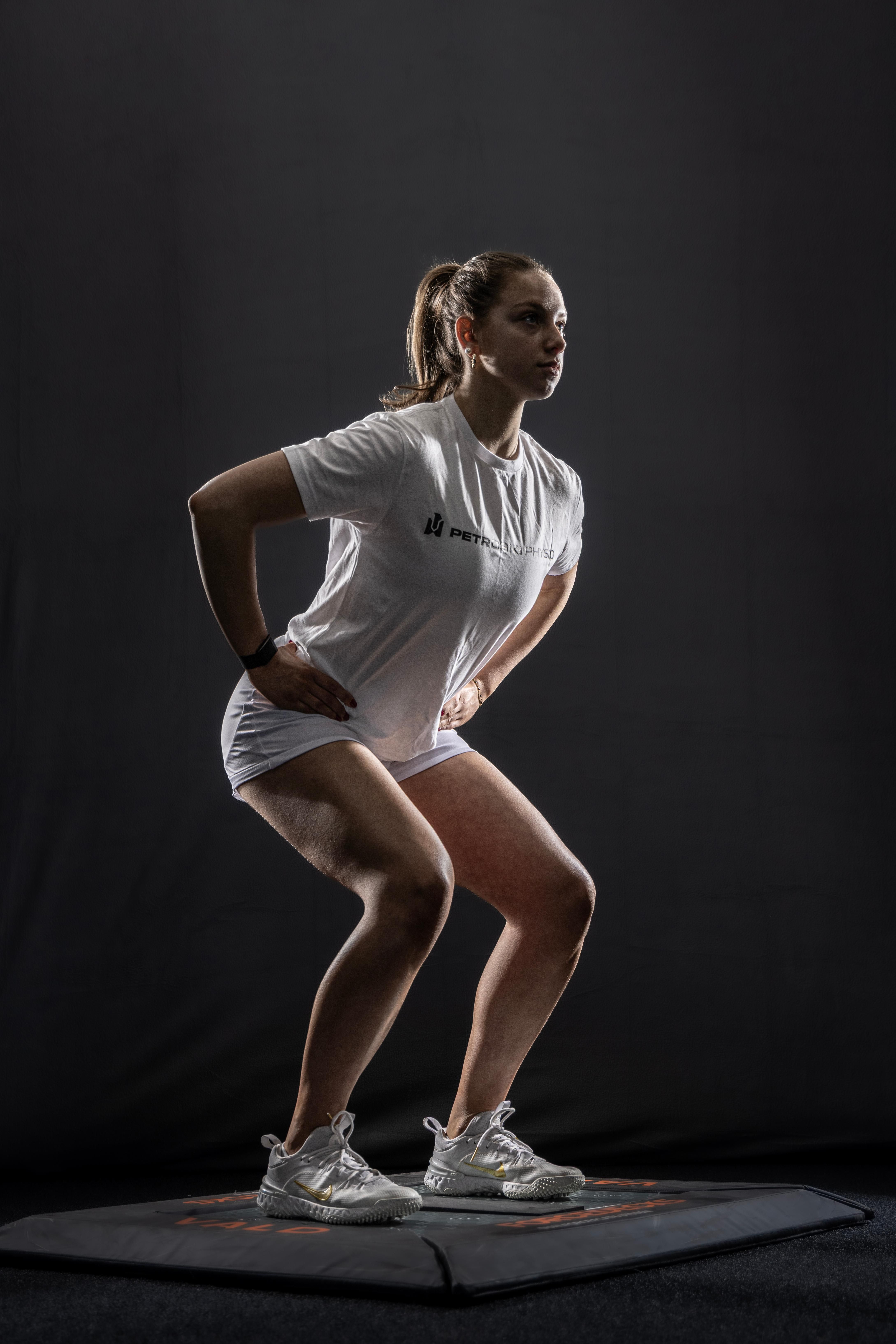
A Powerful Soccer Shot Is a Full-Body Movement
A soccer power shot happens fast.
From the moment the kicking foot leaves the ground to ball contact, an athlete has to coordinate the trunk, pelvis, hip, knee, ankle, and plant leg to transfer force into the ball.
When all of this happens in a fraction of a second, it can be difficult to see why an athlete’s shot has changed.
Maybe they are not generating the same power after an injury. Maybe the ball consistently travels higher than intended. Maybe they experience hip, groin, quadriceps, or knee pain when striking. Or maybe their kick simply does not feel the way it did before.
At Petroski Physio, soccer kick analysis allows us to slow the movement down, combine what we see with objective physical testing, and better understand what may be limiting an athlete’s performance.
The goal is not to create one “perfect” soccer kick. We want to answer a more useful question:
Is something within this athlete’s kicking mechanics contributing to their pain, performance limitation, or difficulty returning from injury?
There Is No Perfect Soccer Kick
Biomechanical reference values can be helpful, but they are not universal targets.
If a high-level soccer player is healthy, producing excellent ball velocity, and consistently performing at a high level, we are not going to change their mechanics simply because one joint angle differs slightly from a reference value.
Every athlete has different strength, mobility, limb lengths, injury history, playing position, preferred kicking strategy, and years of technical development.
Instead of asking, “Does this athlete’s kick look textbook?” we want to know:
Does this movement strategy work for this athlete?
And after an injury:
What changed?
That distinction matters.
The Four Phases of a Soccer Power Shot
We can break a power shot into four main phases:
Backswing
Leg cocking
Acceleration
Follow-through
These phases are connected. Each one sets up what happens next.
A compensation we notice at ball contact, for example, may have started during the backswing. That is why we do not want to take one screenshot of a kick, measure an angle, and immediately call it a problem.
We want to understand the entire sequence.
Phase 1: Backswing
The backswing begins around toe-off of the kicking leg and continues until the athlete reaches maximum hip extension.
During this phase, the kicking leg travels behind the body in preparation to accelerate forward.
Some biomechanical reference positions during the backswing include approximately 30 degrees of hip extension, 50 degrees of knee flexion, and submaximal plantar flexion of the ankle.
These numbers provide context. They are not requirements.
Hip extension helps create the excursion needed to accelerate the leg forward, but more hip extension does not automatically mean a more powerful shot.
If an athlete does not access enough hip extension, they may find another way to create the movement. They may change pelvic motion, extend more through the lumbar spine, change knee position, or alter the timing of the next phase.
This can be particularly relevant when evaluating an athlete after an injury involving the hip flexors, rectus femoris, quadriceps, adductors, or lumbopelvic region.
We are not focused on whether an athlete reaches exactly 30 degrees. We want to know whether they have enough usable motion and strength for their individual kicking strategy.
Phase 2: Leg Cocking
Leg cocking begins around maximum hip extension and continues until the athlete reaches maximum knee flexion.
During this phase, the lower leg folds behind the athlete before rapidly accelerating toward the ball. Think of it like preparing a whip.
The leg does not move forward as one rigid segment. The hip, thigh, knee, lower leg, and foot move in a coordinated sequence that allows velocity to build as the athlete approaches ball contact.
This is also why mobility testing alone is not enough.
An athlete may demonstrate excellent knee flexion while lying on a treatment table but use that motion very differently while kicking at high speed.
At Petroski Physio, we want to know whether the athlete can access and control that motion during the actual task that matters.
Phase 3: Acceleration
The acceleration phase occurs from maximum knee flexion until ball contact.
The thigh travels forward, the knee rapidly extends, and the foot accelerates toward the ball.
A powerful shot requires more than strong quadriceps. The athlete has to coordinate hip motion, knee motion, ankle position, and foot-to-ball contact at high velocity.
For a power shot with the laces, the athlete generally creates a relatively firm foot and ankle at contact to effectively transfer energy into the ball.
This is also where issues that began earlier in the kick may become more noticeable.
An athlete who shortened their backswing may change the timing of knee extension. An athlete returning from a quadriceps injury may reduce how aggressively they accelerate the lower leg. Someone with previous hip flexor or groin pain may protect the hip as kicking speed increases.
What we see at ball contact may be the result of something that happened several frames earlier.
Phase 4: Follow-Through
Ball contact is not the end of the shot.
After producing that velocity, the athlete has to control it.
During follow-through, the hip continues into flexion while the pelvis and trunk rotate and the athlete manages momentum over the plant leg.
This can be particularly important for athletes who experience symptoms during or immediately after striking the ball.
We want to see whether the athlete moves comfortably through the follow-through or begins protecting the kicking leg.
A powerful shot requires both acceleration and deceleration. Producing force matters, but so does controlling it.
Why We Look Beyond the Obvious Compensation
Biomechanical analysis becomes especially useful when we look at the entire movement rather than one position in isolation.
If an athlete’s ankle position looks unusual at ball contact, it would be easy to assume the ankle is the problem. But what if the ankle is compensating for something happening at the hip?
If an athlete does not reach the expected amount of knee flexion during leg cocking, is the knee actually stiff? Or did they shorten their backswing because moving into hip extension is uncomfortable?
Those are different problems and may require different interventions.
At Petroski Physio, we want to identify what is driving the movement strategy, not simply the most obvious compensation.
Don’t Forget About the Plant Leg
It is easy to focus on the kicking leg, but the plant leg plays an important role.
It creates the platform the athlete uses to transfer and redirect force through the rest of the body. That leg has to control the foot and ankle, knee, hip, pelvis, and trunk while the opposite leg accelerates toward the ball.
This can be especially important when a soccer player is returning from ACL reconstruction, meniscus surgery, ankle injury, hip injury, or another lower-extremity injury.
Sometimes the biggest change in the kick is not happening in the kicking leg at all.
The athlete may place the plant foot farther from the ball, shorten their approach, avoid rotating over the leg, or spend less time loading that side.
That is why kick analysis needs to consider the athlete’s entire injury history.
How Petroski Physio Analyzes a Soccer Kick
A power shot happens too quickly to accurately evaluate every component with the naked eye.
Slow-motion video allows us to break the kick into individual phases and examine positions that occur in fractions of a second.
Depending on the athlete and what we are trying to understand, we may look at hip extension during backswing, knee flexion during leg cocking, hip and knee sequencing, ankle position, plant-leg position, pelvic movement, trunk position, ball contact, and follow-through mechanics.
We can then combine those observations with joint-angle measurements, physical examination findings, symptoms, and objective performance testing.
Measuring an angle is not the end goal.
The value comes from understanding what that measurement means for that athlete.
Combining Biomechanics With Objective Strength Testing
Video gives us one part of the story. Strength testing gives us another.
If an athlete is not moving into their typical hip extension during the backswing, we still need to understand why.
Is it mobility? Pain? Apprehension? Strength? A change in movement strategy after injury?
Objective strength testing can help us investigate those questions.
For soccer athletes, testing may include kicker-position hip flexion, hip extension, hip adduction, hip abduction, knee extension, and knee flexion.
Instead of simply saying a muscle “feels weak,” we can quantify how much force the athlete produces and compare that information with their kicking mechanics.
For example, if a player demonstrates altered mechanics after a hip flexor injury and also shows a meaningful reduction in kicker-position hip-flexion force, those findings together provide more context.
We are connecting the strength number to the athlete’s performance.
Why Side-to-Side Symmetry Is Not Enough
Comparing the left leg with the right can be useful, but it does not tell us everything.
Imagine an athlete produces 200 N of hip-flexion force on both sides. That is perfect symmetry.
But what if that athlete previously produced 250 N?
Both sides could be equally underprepared.
That is why we interpret testing using as much context as possible, including side-to-side differences, previous testing, team or group averages, playing position, competitive level, symptoms, injury history, and changes throughout rehabilitation.
For an injured athlete, their own previous performance may be one of our most valuable reference points.
We are not only asking whether they are “normal.”
We are asking whether they are getting back to their normal.
Comparing the Athlete Before and After Injury
If we have video or testing from before an injury, we can compare the athlete with themselves rather than relying only on a textbook model.
Did the backswing shorten? Did maximum knee flexion change? Is the plant foot positioned differently? Has the approach changed? Is there less pelvic rotation? Does the follow-through look guarded?
When those observations are combined with strength testing, symptoms, and performance data, we can develop a more complete picture of the athlete’s recovery.
This can be particularly useful following ACL injuries, quadriceps injuries, rectus femoris strains, hip flexor injuries, adductor and groin injuries, hamstring injuries, hip injuries, and ankle injuries.
The goal is not to make the post-injury kick look prettier.
It is to determine whether the athlete has recovered the movement options and physical capacity necessary to perform again.
When Different Mechanics Don’t Need to Be Changed
Not every biomechanical difference needs to be corrected.
Suppose a high-level player uses approximately 25 degrees of hip extension during their backswing when a reference value suggests approximately 30 degrees.
They are healthy. Their shot is powerful and accurate. They have kicked that way successfully for years.
Do we need to change those five degrees simply because a reference value is different?
No.
We are more interested in biomechanical differences when they occur alongside pain, reduced shot power, loss of accuracy, recent injury, a meaningful change from previous mechanics, objective strength or mobility deficits, or difficulty performing a specific soccer task.
Movement should not be changed simply because it looks different. There should be a reason.
From the Treatment Table to the Soccer Field
Identifying a limitation only matters if it changes how we train.
Depending on what we find, rehabilitation may address hip mobility, hip-flexor strength, hip-extension capacity, quadriceps strength, adductor strength, plant-leg stability, rotational strength and control, rate of force development, or high-speed kicking capacity.
But eventually, the athlete has to kick.
We cannot fully prepare a soccer player for high-velocity shooting with isolated strengthening alone.
A return-to-kicking progression may move from:
Short passing → longer passing → controlled striking → submaximal shooting → high-velocity shooting → reactive finishing → full training and competition
The exact progression depends on the athlete and injury.
The principle is to build physical capacity in the clinic and then progressively help the athlete express it on the field.
More Data Doesn’t Automatically Mean Better Rehab
Sports performance technology allows us to collect a lot of information.
We can measure strength and joint angles. We can slow movement down frame by frame. We can calculate side-to-side differences and compare an athlete with previous testing or team averages.
But collecting data is not the same as making a good decision.
The important question is:
Why are we measuring it?
If an athlete has pain, we want to understand whether their mechanics and physical capacity help explain their symptoms.
If performance has declined, we are looking for meaningful changes.
If they are returning from injury, we want to determine whether they have restored the qualities necessary for soccer.
And if they are healthy, pain-free, and performing at a high level, we are not going to manufacture a problem because one angle does not perfectly match a reference value.
The Petroski Physio Approach to Soccer Performance
At Petroski Physio, our goal is to bridge the gap between rehabilitation and performance.
For a soccer player, being pain-free in the clinic is not necessarily the finish line.
Can you sprint? Cut? Decelerate? Strike a ball? Repeatedly produce high-velocity kicks? Confidently plant on the previously injured leg? Perform those tasks under fatigue? And do it again at your next training session?
Those are the questions that matter when preparing an athlete to return to soccer.
Biomechanical analysis gives us another tool to help answer them.
The Takeaway
A powerful soccer shot is not created by one muscle or one perfect joint angle.
It is a coordinated sequence:
Backswing → Leg Cocking → Acceleration → Ball Contact → Follow-Through
Each phase influences what happens next.
That is why soccer power-shot analysis at Petroski Physio is not about forcing every athlete into the same textbook model.
We combine slow-motion biomechanics, objective strength testing, symptoms, injury history, performance demands, and the athlete’s previous data to understand the individual in front of us.
The goal is not to chase perfect angles. It is to determine whether the athlete has the strength, movement options, speed, and confidence needed to kick at their highest level.
And when an athlete is returning from injury, we want to do more than help them become pain-free.
We want to help them get back to performing like a soccer player.
This article is intended for educational purposes and does not replace an individualized physical therapy or sports-performance evaluation. Biomechanical reference values should be interpreted in the context of the individual athlete rather than used as universal movement targets.
Rehab, different.
Not a clinic. Not a gym.
A place built for progress.
A team built for performance.
A culture built for you.