Rotator Cuff Shoulder Pain and Your MRI
Shoulder imaging can provide useful information, but it does not tell the whole story. Learn how strength, function, workload, and your individual goals help guide rotator cuff rehabilitation.
Pat Meenan DPT
Rotator Cuff Shoulder Pain: Why Your MRI Does Not Tell the Whole Story
Shoulder pain is common in everyone from high school and college athletes to recreational lifters, active adults, and older patients who simply want to reach overhead comfortably.
One common category is rotator cuff related shoulder pain (RCRSP). This broad term can include rotator cuff tendinopathy, subacromial bursitis, partial-thickness rotator cuff tears, and full-thickness rotator cuff tears.
For years, many of these problems were described as shoulder "impingement," based on the idea that a tendon was being pinched underneath the acromion. The picture is more complicated than that.
For most patients, the goal of rehabilitation is not to create a "perfect" shoulder on an MRI. The goal is to build a shoulder that is strong, confident, and capable of handling the activities that matter to you.
Your MRI Is Only One Piece of the Puzzle
An abnormality on an MRI does not automatically explain why your shoulder hurts.
Rotator cuff changes become more common with age, and some people have tendon degeneration or even rotator cuff tears without symptoms.
An MRI can tell us what your shoulder looks like, but it does not automatically tell us how well your shoulder functions.
This matters when an MRI report includes words such as:
Tendinosis
Partial tear
Labral changes
Bursitis
Degeneration
Those findings can sound alarming, but they do not automatically mean your shoulder is damaged beyond repair or that you need surgery.
Imaging can be extremely valuable when there is concern for a significant injury or another condition requiring further medical evaluation. For many common rotator cuff problems, however, treatment should also be guided by your symptoms, strength, function, goals, and response to loading.
A Rotator Cuff Tear Does Not Automatically Mean a Weak Shoulder
It is easy to assume that if part of a tendon is torn, the shoulder can no longer function properly. The body can be more adaptable than that.
The rotator cuff contains a structure called the rotator cable, which acts somewhat like a suspension bridge. It helps redistribute forces around portions of the tendon that may be injured.
Because of this, some people can maintain good shoulder strength and function despite having a tear.
Think of a small hole in a sock. The sock may not be structurally perfect, but it can still do its job.
A similar idea applies to the shoulder.
This is especially important for athletes. Baseball players, swimmers, volleyball players, quarterbacks, tennis players, and other overhead athletes may show changes on imaging while continuing to perform at a high level.
Structure and function are related, but they are not the same thing.
For Athletes, Shoulder Rehab Is About Building Capacity
For a high school or college athlete, simply getting the shoulder pain-free is usually not enough.
The shoulder eventually needs to tolerate throwing, high-speed arm movements, deceleration, repeated overhead activity, weight-room training, contact or other sport-specific demands, and multiple practices or games throughout the week.
That is why we think about rehabilitation as building capacity.
Early in rehab, an athlete may start with relatively simple exercises such as external rotation, rowing, pressing, pulling, or isometric strengthening.
As symptoms improve, those exercises should progress.
An overhead athlete may eventually need:
Heavier strength training
Faster movements
Plyometric exercises
Medicine-ball work
Rate-of-force-development training
Deceleration exercises
Sport-specific positions
Progressive throwing exposure
The endpoint is not simply, "Can you perform three sets of band external rotations?"
The better question is:
Can your shoulder tolerate the speed, force, volume, and fatigue associated with your sport?
Rest Is Usually Not the Long-Term Solution
Rotator cuff tendons respond to mechanical loading.
Complete rest may temporarily calm symptoms, but avoiding shoulder loading indefinitely does not prepare the shoulder for a return to activity.
Rehabilitation usually starts by finding a manageable level of activity and gradually increasing the stress the shoulder can tolerate.
Someone with significant pain may begin with low-level isometrics or lighter resistance. Someone with mild pain may be able to begin strengthening right away.
For athletes, the program eventually needs to reflect the demands of their sport.
The same principle applies outside of sports. If your goal is to put luggage into an overhead compartment, work in the yard, lift your grandchildren, golf, or return to the gym, rehabilitation should gradually prepare your shoulder for those activities.
Is Pain During Exercise Always Bad?
Not necessarily.
For many patients with rotator cuff related shoulder pain, some discomfort during exercise can be acceptable.
A useful guideline is that symptoms should stay manageable during the exercise and should not cause a meaningful increase in pain afterward or the following morning.
That does not mean ignoring severe pain. It means recognizing that pain and tissue damage are not always the same thing.
Sometimes the shoulder is sensitive to a movement or load it has not tolerated recently. In that situation, we can temporarily modify the movement or load and progressively rebuild tolerance.
Compression Does Not Automatically Mean Damage
Patients are sometimes told that certain shoulder positions are "pinching" or "damaging" the rotator cuff.
That language can make people afraid to move.
Many tendons experience compression during normal movement. A throwing athlete, for example, may experience symptoms when the arm reaches the late-cocking or "lay-back" position. A lifter may notice discomfort during an overhead press.
Rather than saying, "That position is damaging your shoulder," a more useful explanation may be:
"Your shoulder is sensitive to that position right now, so we're going to temporarily reduce the stress and progressively build your tolerance back up."
One message encourages avoidance. The other focuses on adaptation.
Confidence Matters More Than Most People Realize
Fear of movement, also known as kinesiophobia, can play an important role in shoulder rehabilitation.
Rehabilitation does not always work because a tendon completely heals or every strength measurement dramatically improves. Patients may improve even when imaging remains essentially unchanged.
Part of rehabilitation is helping someone become comfortable and confident with movement again.
This can be especially important for throwing athletes.
An athlete returning from shoulder pain may physically be able to throw but still be hesitant to reach back into full external rotation, accelerate the arm, release the ball, or throw at maximum effort.
That fear can affect mechanics, performance, and the return-to-sport process.
A good return-to-throw program should therefore build both physical capacity and confidence.
Shoulder Rehab Should Be Built Backward From Your Goal
There is no single perfect rotator cuff exercise program.
A 55-year-old recreational golfer and a 19-year-old college pitcher may begin rehabilitation with similar exercises. Both might perform rotator cuff strengthening, rows, pressing, pulling, scapular strengthening, and general upper-body resistance training.
But their programs should eventually look very different.
The golfer may need enough strength, range of motion, and tolerance to repeatedly swing without pain.
The pitcher may need exposure to:
High-speed external and internal rotation
Plyometrics
Rapid force production
Throwing volume
Deceleration
Fatigue
High-intensity sport-specific positions
Rehabilitation should answer one important question:
What does this person ultimately need their shoulder to do?
Then we work backward from that goal.
For Throwing Athletes, Pitch Count Is Only Part of the Story
Pitch counts are useful, particularly in youth baseball, but one game's pitch count does not tell us everything about an athlete's workload.
Total weekly throwing exposure matters too. That can include:
Bullpens
Long toss
Flat-ground throwing
Warm-up throws
Infield or outfield throws
Private lessons
Showcases
Multiple teams
Strength training
Previous games and practices
The body responds to cumulative workload and recovery, not only the number of pitches recorded during one outing.
For developing athletes especially, conversations about throwing should include both volume and recovery.
What About Injections?
Injections can have a role in shoulder care, but they should not automatically be the first option.
Corticosteroid injections can provide meaningful short-term pain relief for some patients, but the benefit tends to decrease over time. Repeated corticosteroid injections also deserve caution because of potential effects on tendon quality.
PRP has received significant attention, but current evidence has not clearly demonstrated that it consistently outperforms a well-structured rehabilitation program for standard rotator cuff related shoulder pain.
Shockwave therapy may have a role in certain cases, particularly calcific tendinopathy, but it is not usually the primary treatment for routine RCRSP.
For most patients, the foundation remains:
Education + progressive loading + graded return to activity.
What About Surgery?
Some rotator cuff injuries require an orthopedic consultation, particularly traumatic or massive tears associated with significant weakness or loss of function.
However, seeing the word "tear" on an MRI does not automatically mean surgery is necessary.
Many rotator cuff tears can be managed without surgery.
Even after surgical repair, the tendon does not always remain completely intact. Re-tears can occur, particularly with larger tears and increasing age. Structural healing and patient function also do not always perfectly correlate.
That is another reason we pay close attention to how a patient actually feels and functions, not simply what appears on an MRI.
A Simple Example We Use in the Clinic
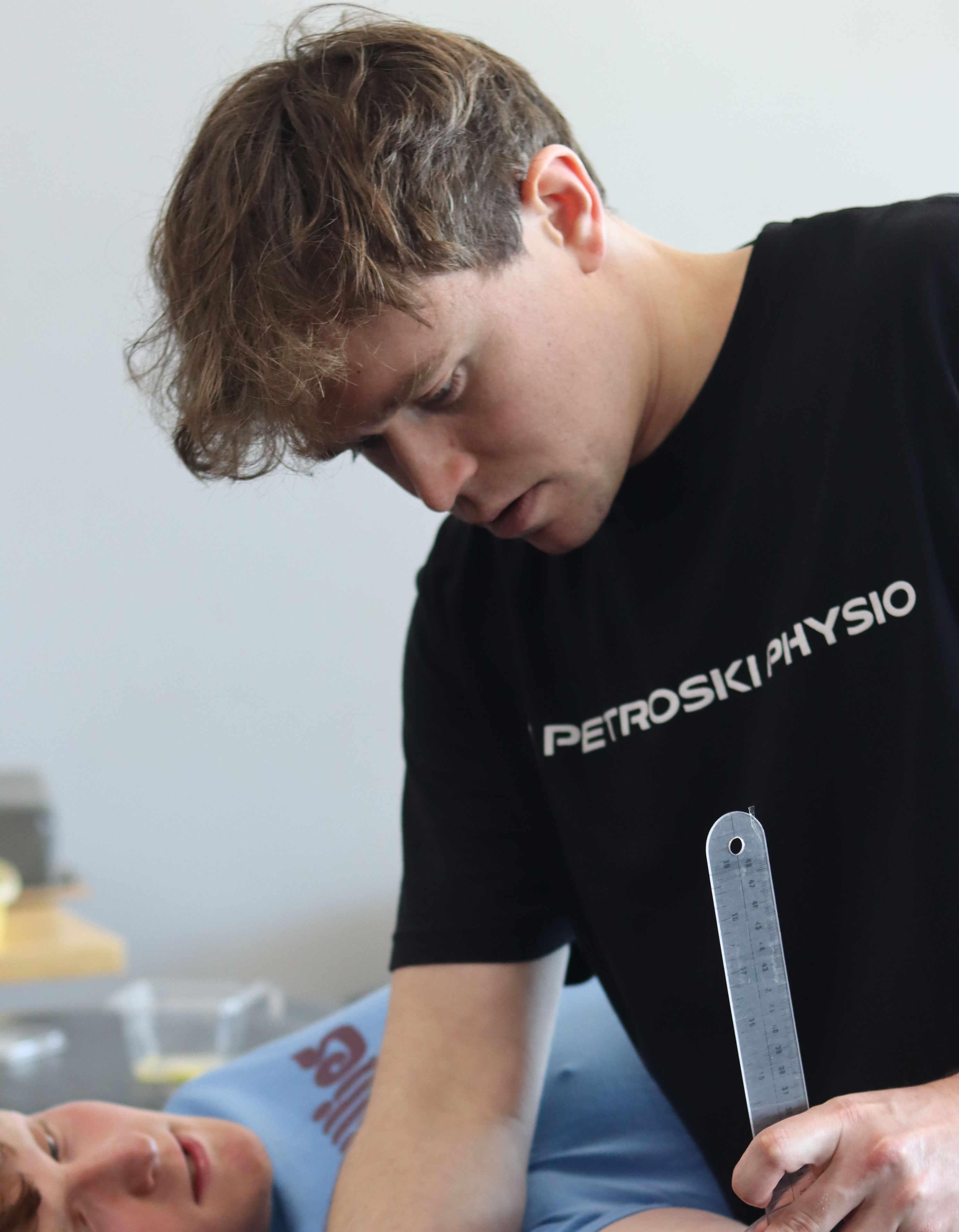
One exercise we can use to help patients understand shoulder capacity is side-lying external rotation.
We may have someone perform external rotation with a light dumbbell until fatigue on each side. Sometimes the painful shoulder fatigues significantly faster.
Instead of pointing to an MRI and saying, "Your tendon is damaged," we can show the patient something they can work on:
"Your shoulder currently has less capacity. Let's build that capacity."
That gives the patient a clear and active role in rehabilitation.
The Same Principle Applies to a Painful Arc
Another common complaint is pain while raising the arm through a particular range, often around shoulder height.
Instead of completely avoiding that movement, we may change the position slightly. For example, moving the arm into the scapular plane may allow the patient to raise it with significantly less discomfort.
This can be an important teaching moment.
Your shoulder is not necessarily fragile. Small changes in position, load, speed, or volume can change symptoms significantly.
From there, we can gradually restore tolerance to movements that were previously painful.
The Biggest Takeaway
Whether you are a high school baseball player, college volleyball athlete, recreational lifter, or an active adult trying to stay that way, rotator cuff related shoulder pain does not automatically mean your shoulder is damaged beyond repair.
An MRI finding does not determine your future.
For most people, effective rehabilitation focuses on:
Understanding the problem
Reducing unnecessary fear
Building rotator cuff and upper-body strength
Progressively increasing shoulder capacity
Gradually reintroducing painful or provocative positions
Managing total workload and recovery
Preparing specifically for the activity or sport you want to return to
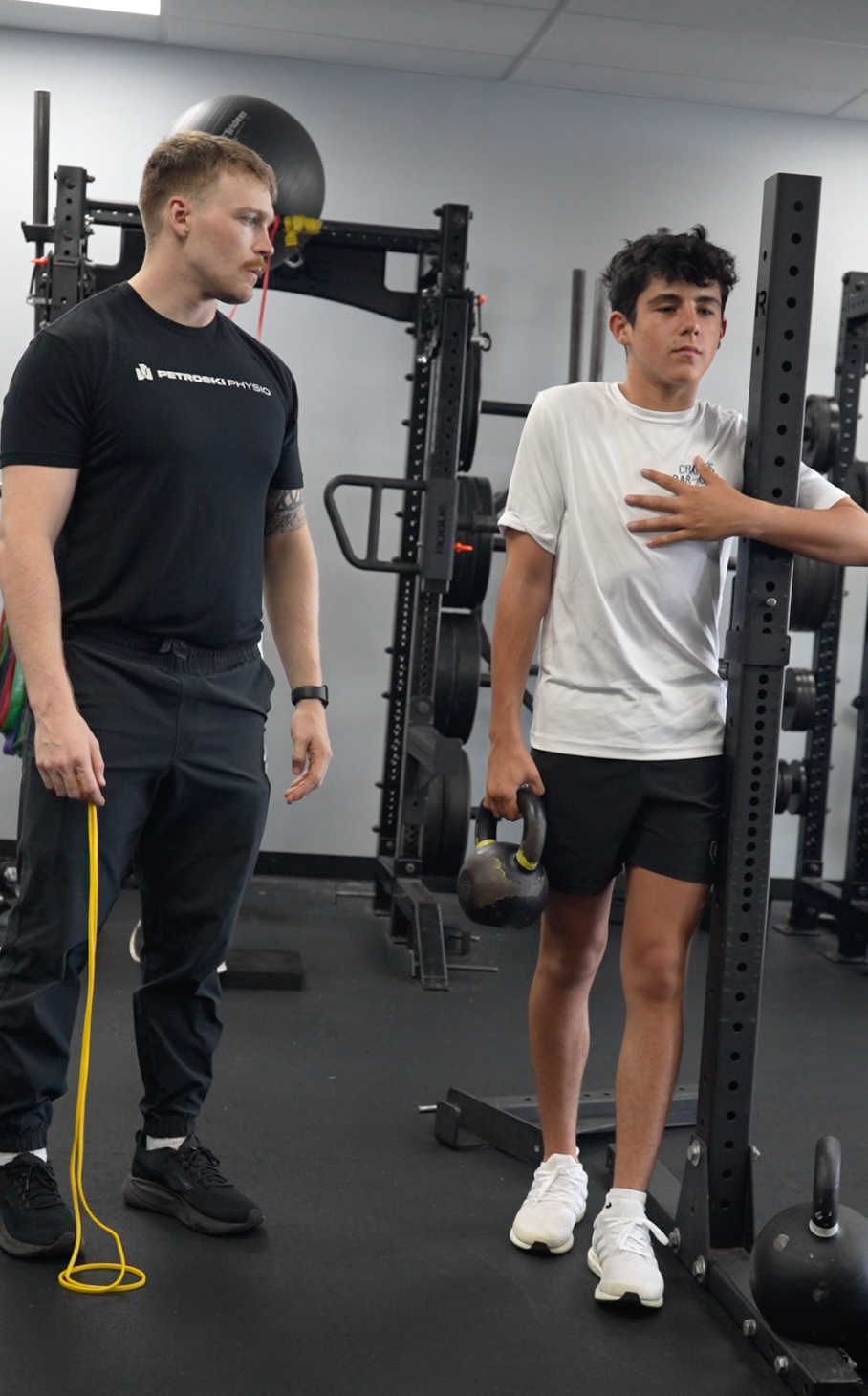
At Petroski Physio, the goal is not simply to chase a perfect-looking MRI or get you through a few basic shoulder exercises. Rehabilitation should prepare your shoulder for what you actually need it to do, whether that's throwing, lifting, competing, working, or staying active.
The goal is a shoulder that is strong enough, prepared enough, and confident enough to handle what you ask of it.
Shoulder pain keeping you from throwing, lifting, training, or staying active? Petroski Physio can assess how your shoulder moves and performs, identify what is limiting you, and build a rehabilitation plan around the activities you want to get back to.
Rehab, different.
Not a clinic. Not a gym.
A place built for progress.
A team built for performance.
A culture built for you.