Why Flexible Gymnasts Need Strength to Control Their Range
Gymnasts need more than flexibility. Learn how strength, active range of motion, and end-range control help athletes use their mobility more effectively in gymnastics.
Reece Sullivan Performance Intern & Sean Kelley Strength and Conditioning Coach
Beyond Flexibility: Why Gymnasts Need Strength to Control Their Range
Flexibility is one of the defining qualities of gymnastics.
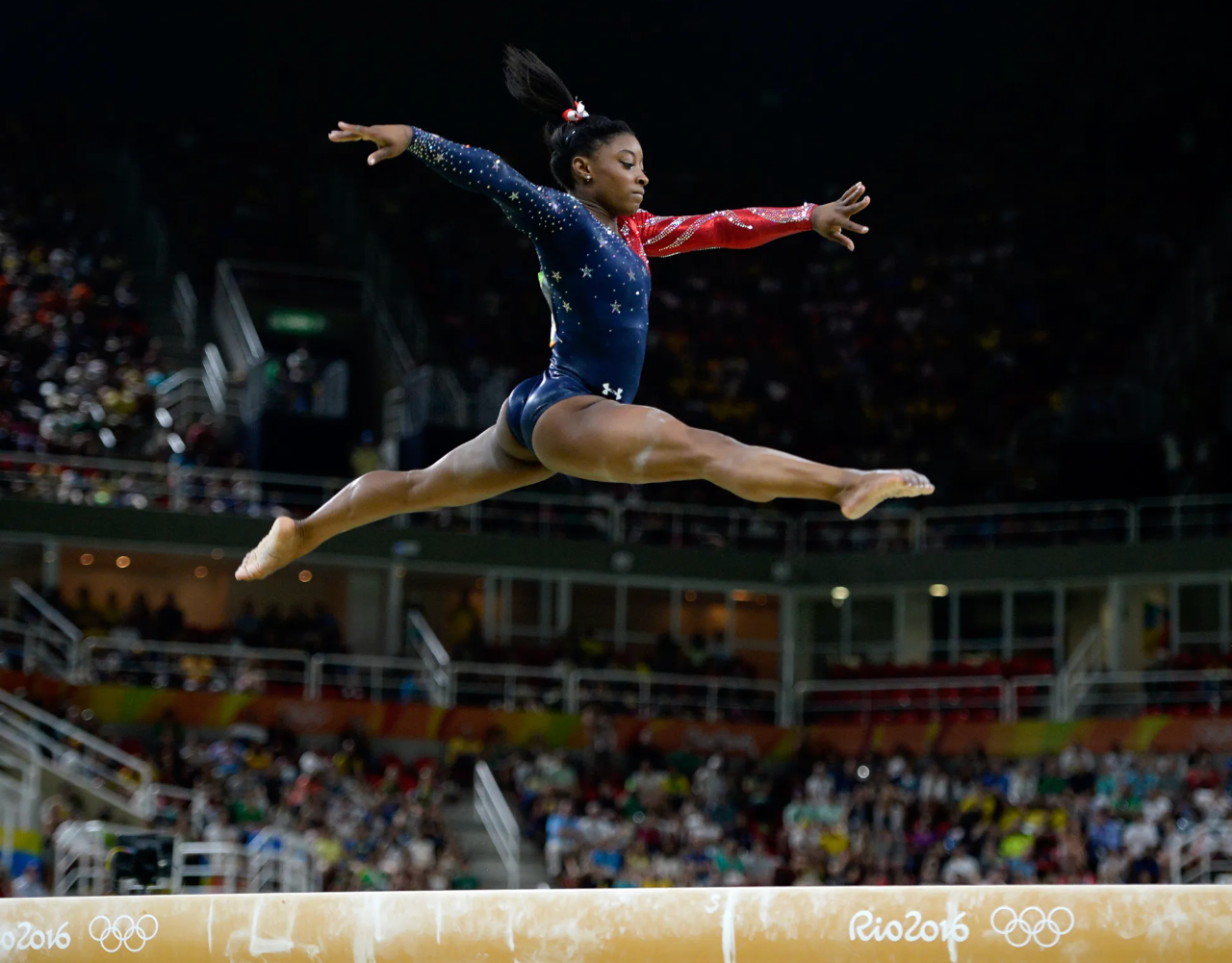
It allows athletes to perform splits, leaps, bridges, handstands, walkovers, and other skills that require ranges of motion far beyond what is expected in most sports.
But flexibility alone is not enough.
A gymnast may be able to reach an extreme position without having the strength, stability, or body awareness to control it. When that happens, the athlete may rely more heavily on passive structures such as the ligaments, joint capsule, and surrounding connective tissue to hold the position.
The goal is not to take flexibility away from a hypermobile gymnast. That mobility may be one of the athlete's biggest performance advantages.
The goal is to help the gymnast become strong enough to control, load, and use the range they already have.
Flexibility and Hypermobility Are Not the Same
Flexibility describes how far a muscle and joint can move through a particular range.
Hypermobility describes a joint that moves beyond the range typically expected for that joint. It may affect one area or be present throughout the body.
A gymnast can be flexible without being globally hypermobile. A hypermobile gymnast can also have a large amount of available motion without having strong control through that motion.
That difference matters.
A gymnast may be able to drop into a deep split but struggle to actively lift and hold the leg at the same height. Another athlete may have a large backbend but lack the abdominal, hip, shoulder, and spinal strength needed to control that position.
The question is not only how much motion the gymnast has.
It is how much of that motion the gymnast can actively control.
Hypermobility Can Be an Advantage in Gymnastics
In gymnastics, having more motion can be useful.
Hypermobility may help an athlete achieve deeper split positions, larger leaps, stronger bridge shapes, improved overhead positions, greater movement amplitude, and easier access to certain technical positions.
For some gymnasts, that natural mobility is an important part of performance.
The problem is not necessarily that the athlete can reach an extreme position.
The problem starts when the athlete can reach it but cannot stabilize or control it.
Do Not Automatically Try to Reduce the Athlete's Mobility
A hypermobile gymnast does not necessarily need to become less flexible.
Mobility is part of gymnastics. Dramatically limiting an athlete's available range may interfere with the positions and skills required by the sport.
Instead of asking, "How do we reduce this gymnast's flexibility?" a better question is, "How do we build enough strength and control to make this flexibility usable?"
The goal is not to eliminate range.
It is to improve the gymnast's ability to control that range during speed, fatigue, impact, and external load.
Passive Range and Active Range Are Different
Passive range of motion is how far a joint can move with help from gravity, the floor, a coach, or another external force.
Active range of motion is how far the athlete can move and hold the joint using their own muscular control.
This difference is especially important in gymnastics.
A gymnast may be able to lie on her back while a coach pushes her leg into a deep split position. But if she cannot actively lift and hold the leg near that position during a leap, scale, or beam skill, she does not fully control that range.
The larger the gap between passive and active motion, the more the gymnast may rely on passive structures near the end of the range.
The answer is not always more stretching.
Often, the athlete needs more strength in the range she already has.
Why Strength Training Matters for Flexible Gymnasts
Strength training helps provide active muscular support around joints that move through large ranges.
Passive structures such as ligaments and the joint capsule contribute to stability. Muscles provide active control.
For a flexible or hypermobile gymnast, those muscles need to be able to:
Control joint position
Slow movement before the end of the range
Produce force from extended positions
Absorb force during landings
Maintain alignment as fatigue builds
Respond when body position changes unexpectedly
There is no single strength program that is right for every hypermobile athlete.
For gymnasts, strength training should complement flexibility rather than compete with it.
Strength is what helps make flexibility functional.
Strength Training Does Not Mean Becoming "Too Tight"
One common concern from gymnasts, parents, and coaches is that strength training will make the athlete stiff or reduce mobility.
Appropriately designed strength work does not require sacrificing range of motion.
A gymnast can continue to use large ranges while becoming stronger within those ranges.
The key is choosing exercises that match the demands of the sport and gradually training the athlete through appropriate positions.
That may include full-range movements, end-range isometrics, eccentric loading, single-leg exercises, overhead strength, trunk control, landing preparation, and sport-specific positions.
The goal is not bodybuilding.
The goal is greater capacity.
End-Range Strength Is Key
End-range strength is the ability to create force near the limit of an available range of motion.
That matters in gymnastics because athletes do not simply need to reach positions. They need to control them.
A gymnast does not only need enough hip mobility to reach a split. She needs to control the leg as it approaches that position.
She does not only need enough shoulder flexion for a handstand. She needs to maintain control through the shoulders, ribs, elbows, wrists, and trunk while supporting body weight overhead.
She does not only need spinal extension for a bridge. She needs to distribute that motion through the shoulders, thoracic spine, hips, and lower back rather than relying heavily on one area.
Useful end-range strength exercises may include active split lifts, controlled leg raises, end-range holds, Copenhagen plank variations, overhead carries, handstand shoulder drills, controlled bridge progressions, and slow eccentric hamstring exercises.
These exercises help turn available mobility into usable strength.
Eccentric Strength Helps Control the Path Into a Position
Eccentric strength is the ability to control force while a muscle is lengthening.
Gymnasts use this type of control when lowering into a split, landing from a tumbling pass, absorbing force from a dismount, moving into a bridge, controlling the leg during a leap, or slowing a limb before it reaches end range.
A hypermobile athlete may have no trouble reaching the final position but may struggle to control how quickly she gets there.
That is where eccentric strength becomes important.
Instead of only stretching the hamstrings, for example, a gymnast may use a slow Romanian deadlift to strengthen them while they lengthen.
Instead of dropping passively into a split, the athlete may lower gradually while maintaining muscular tension.
The gymnast still uses the range.
She simply learns to control how she moves into it.
Stability Does Not Mean Stiffness
Stability is not the same as rigidity.
A stable gymnast is not someone who moves less.
A stable gymnast is someone who can control movement.
That may mean maintaining elbow position during a handstand, controlling the pelvis during a leap, preventing the knee from collapsing during a landing, controlling the shoulder during a back handspring, or maintaining foot and ankle position on beam.
The goal is not to make the athlete stiff.
It is to give the gymnast the ability to create control when she needs it while still moving freely through the ranges required by the sport.
Where Hypermobile Gymnasts May Compensate
Hypermobility does not look the same in every athlete, but several areas often deserve extra attention.
Lower Back
A gymnast with a large amount of lumbar extension may repeatedly use the lower back to create a bigger bridge or overhead position.
This may happen when shoulder flexion, thoracic extension, hip extension, or abdominal control is limited.
The goal is not necessarily to remove lumbar extension. It is to avoid relying on one area to create all of the motion.
Shoulders
The shoulders need to be both mobile and strong enough to support body weight.
A gymnast may have enough passive shoulder motion to reach overhead but lack the muscular control needed to maintain that position.
Compensations may show up as elbow hyperextension, rib flare, lumbar extension, scapular winging, or excessive movement at the front of the shoulder.
The athlete should keep the overhead mobility required for the sport while building the strength to control it.
Elbows
Elbow hyperextension can make the arm look fully locked, but the gymnast may be resting on passive structures instead of actively supporting the position.
Strength through the triceps, shoulders, forearms, and scapular muscles can help create a stronger weight-bearing position.
Hips
Large hip ranges can be valuable for splits, leaps, and dance elements.
But without enough strength from the glutes, adductors, hip flexors, and deep rotators, the athlete may struggle with pelvic control.
Compensation may show up through the pelvis, lower back, knee, or foot.
Knees
A hypermobile gymnast may stand or land with the knees pushed beyond neutral.
The athlete should learn the difference between creating the straight line required by the sport and simply hanging into the back of the joint.
Ankles and Feet
Gymnasts need enough plantar flexion to create a strong toe point.
They also need muscular control through the calf, foot, and ankle to manage takeoffs, landings, and beam positions.
The toe point should not only look strong.
It should be actively controlled.
Strength Training Should Match the Demands of Gymnastics
General strength is important, but gymnastics also requires strength in very specific positions.
Lower-body training may include squats, split squats, step-ups, deadlift variations, Romanian deadlifts, calf raises, single-leg squats, and hamstring curls.
Upper-body work may include push-ups, pull-ups, rows, overhead pressing, handstand holds, scapular push-ups, serratus strengthening, and rotator-cuff exercises.
Trunk training should help the athlete control spinal and pelvic motion through positions such as hollow-body and arch-body shapes.
End-range work may include active flexibility drills, isometric holds, loaded mobility, controlled transitions into split positions, and shoulder control at full elevation.
Landing training may include snap-downs, stick landings, single-leg landing drills, repeated jump preparation, and deceleration work.
Strength is not only about producing force.
It is also about controlling and absorbing it.
When More Stretching Is Not the Answer
Gymnasts spend a lot of time stretching.
Some athletes need that work to reach the positions required by the sport.
But if a gymnast already has significant passive range, repeatedly forcing deeper positions may not address the real limitation.
Before adding more flexibility work, it is worth asking whether the athlete actually lacks range or whether the bigger issue is strength, control, technique, or how the athlete is creating the position.
The goal is not to eliminate stretching.
The goal is to make it purposeful.
A gymnast who already has the required passive motion may benefit more from active flexibility and strength than from simply pushing farther.
Active Flexibility Should Be a Priority
Active flexibility combines mobility with strength.
Instead of using an external force to move into a position, the gymnast uses her own muscles to create and hold the range.
Examples may include leg lifts, scale holds, split jumps, controlled battements, pike compression lifts, active shoulder flexion, handstand line drills, bridge kickover preparation, and press-handstand compression work.
This has a direct connection to performance.
A coach cannot push a gymnast's leg higher during a leap.
The athlete has to create that position herself.
The more of her available range she can actively control, the more useful that flexibility becomes.
Body Awareness Matters
A hypermobile gymnast may have difficulty identifying exactly where a joint is positioned, especially near the end of the range.
This does not mean every hypermobile athlete has poor body awareness, but joint-position control is worth assessing.
Training may challenge the gymnast through balance work, beam drills, closed-chain shoulder exercises, slow transitions, isometric holds, landing tasks, or other controlled positions.
The goal is to help the athlete understand what a strong, controlled position feels like instead of only chasing more range.
Fatigue Can Change Control
A gymnast may show excellent alignment early in practice and lose that control as fatigue builds.
That matters because the muscles play an important role in supporting joints with large ranges of motion.
As the athlete becomes tired, you may see more knee hyperextension, elbow collapse, rib flare, loss of pelvic control, heavier landings, reduced balance, or increased lumbar extension.
This is why strength endurance matters too.
The gymnast needs to maintain control late in practice and through repeated routines, not only during a single drill or evaluation.
How to Evaluate a Flexible Gymnast
A performance evaluation should look beyond whether the gymnast can reach impressive positions.
It may include passive and active range of motion, side-to-side differences, end-range strength, joint-position control, landing mechanics, upper-body weight-bearing strength, hip and trunk control, foot and calf strength, fatigue response, training load, pain history, and whether hypermobility is localized or more generalized.
The Beighton score may help identify generalized joint hypermobility, but it does not describe everything that matters for a gymnast.
It should be one part of the evaluation, not the entire evaluation.
A Better Way to Think About Flexibility
Flexibility is not automatically good or bad.
It is simply a physical quality.
What matters is whether the athlete can control it and use it effectively.
A helpful way to think about it is:
Mobility provides access.
Strength provides control.
Power allows expression.
Technique determines how those qualities are used.
A gymnast needs all four.
The goal is not to remove flexibility or to add strength without considering the athlete's range.
The goal is to develop both together.
Final Thoughts
Gymnastics demands exceptional ranges of motion.
For many athletes, natural hypermobility helps them reach positions that are important for performance. That should not automatically be treated as something that needs to be corrected.
Instead, the focus should be on helping the athlete develop the strength and control to use that mobility well.
That may include active flexibility, end-range strength, eccentric control, joint stability, body awareness, strength endurance, landing capacity, and sport-specific strength.
The best gymnast is not simply the athlete who can move the farthest.
It is the athlete who can control and use that movement.
Flexibility creates possibilities.
Strength helps the gymnast own them.
Rehab, different.
Not a clinic. Not a gym.
A place built for progress.
A team built for performance.
A culture built for you.